
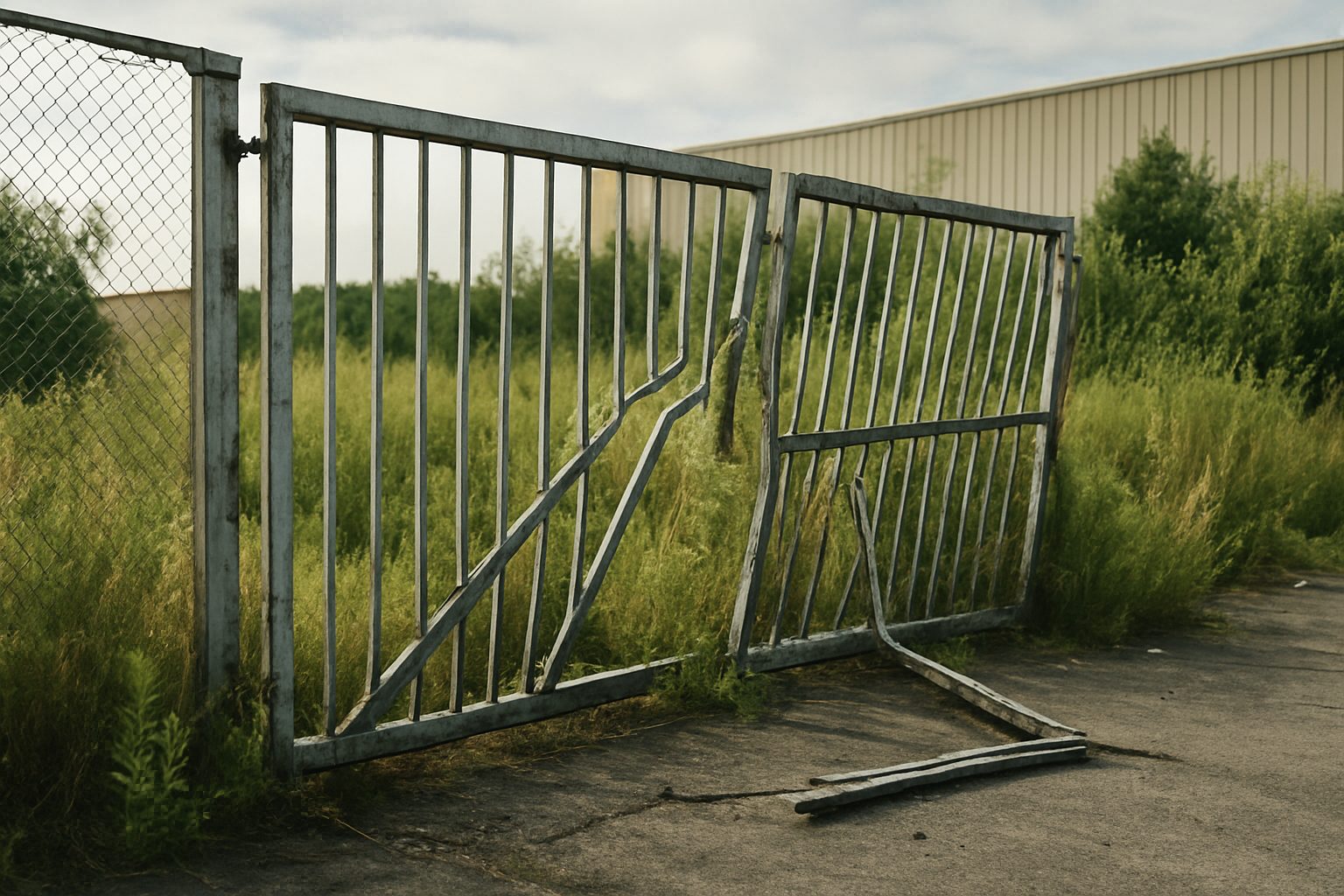
Most business owners know exactly how much stock, equipment and machinery they have inside their premises. Far fewer pay the same attention to what happens around the outside of the building once everybody has gone home. Yet a poorly secured yard, damaged gate or neglected section of commercial fencing can leave an otherwise well-protected business unnecessarily exposed.
It’s a strange contradiction.
Companies will spend thousands on alarm systems, CCTV and reinforced doors while overlooking a boundary that somebody could walk through without much difficulty.
I’ve seen industrial yards with impressive security cameras overlooking gates that barely close properly. I’ve seen expensive access systems installed alongside perimeter fencing that has clearly been damaged for months.
Security is only as effective as the weaknesses surrounding it.
And those weaknesses aren’t always where people expect them.
Security doesn’t begin at the building
The first mistake is treating the external boundary as something separate from the security of the premises.
For a business operating from a warehouse, workshop, storage yard or industrial unit, the perimeter is the first physical obstacle between the public and whatever needs protecting.
That might be vehicles, materials, tools, equipment or access to the building itself.
A secure perimeter creates separation. It helps control where people enter, discourages casual trespassing and makes unauthorised access more difficult.
It also gives employees and security personnel a clearer understanding of where the controlled area begins.
None of this means every business needs an enormous steel fence topped with intimidating security features.
A small workshop on an established industrial estate has different requirements from a distribution centre with valuable stock stored outside.
The important thing is that the boundary matches the actual risks.
Too often, fencing is treated as an afterthought. Something installed when the building was first occupied and largely forgotten until a vehicle hits it or a storm brings down a section.
That approach can become expensive.
The weakest section is rarely the main entrance
Business owners naturally concentrate on the front gate.
It’s the part everybody sees. Deliveries arrive through it, employees use it and customers may pass through it regularly.
As a result, the entrance often receives the greatest investment.
The problem is that the rest of the perimeter may be considerably less secure.
Walk around the outside of a typical industrial property and you might find a different story behind the building.
An older section of chain-link fencing. A loose panel beside a storage container. A damaged post hidden behind vegetation. A boundary adjoining unused land that nobody has inspected properly for years.
These areas are easy to overlook because they aren’t part of the daily routine.
A rear boundary might be visible from an upstairs office window, but that doesn’t mean anybody has checked its condition recently.
There is a practical lesson here.
Security inspections should follow the entire perimeter, not simply the route people normally use to enter the premises.
A strong front gate is of limited value if another section provides substantially easier access.
A gate that closes isn’t necessarily a secure gate
Gates deserve particular attention because they combine structural requirements with moving parts.
Unlike a fixed fence, a gate is opened, closed, pushed, pulled and occasionally struck by vehicles.
Industrial gates can be heavy. Their hinges, posts, frames and locking arrangements must cope with repeated use.
Over time, small problems develop.
A supporting post moves slightly. A hinge wears. A gate drops out of alignment. The latch becomes difficult to engage.
Employees start compensating.
Perhaps they lift the gate to close it. Maybe they pull it sharply until the locking mechanism catches. Sometimes a gate is left unsecured temporarily because operating it has become inconvenient.
Temporary arrangements have a habit of becoming permanent.
A properly functioning gate should close reliably, align correctly and allow its locking system to work as intended.
If it doesn’t, the answer isn’t necessarily a stronger padlock.
The underlying mechanical or structural problem needs identifying.
This is especially important for large gates, where excessive weight, movement or damaged components can create safety risks as well as security weaknesses.
CCTV can’t compensate for poor physical protection
CCTV has an important role in commercial security.
It can help monitor activity, support investigations and provide valuable evidence when incidents occur.
But cameras and fences perform different jobs.
A camera records or monitors what happens. A physical boundary is intended to control access and create an obstacle.
One doesn’t automatically replace the other.
There is also a tendency to assume that visible cameras make every other security measure less important.
They don’t.
A camera overlooking a damaged perimeter might record an intrusion, but that doesn’t mean the boundary was doing its job.
The strongest arrangements generally use several complementary measures.
Appropriate perimeter fencing, controlled gates, lighting, alarms and surveillance can all contribute, depending on the nature of the premises.
The objective isn’t to make a business look like a prison.
It’s to remove obvious opportunities and make unauthorised access more difficult.
Storage yards present a different problem
Businesses that store materials or equipment outdoors face additional challenges.
Builders’ merchants, engineering firms, vehicle businesses, agricultural suppliers and other commercial operators may have valuable assets outside the main building.
These yards are often busy places.
Vehicles arrive. Forklifts move materials. Deliveries are unloaded. Temporary storage arrangements become established.
Over time, equipment can end up positioned against fencing or close to access gates.
That creates several problems.
Heavy materials may damage panels or posts. Poorly positioned stock can obstruct inspection routes. Storage containers and stacked equipment can conceal sections of the perimeter.
Even routine vehicle movements can gradually damage fencing if turning space is inadequate.
A bent post might not seem particularly urgent when the gate still works and the yard is busy.
Six months later, the same damage may have developed into a more serious structural problem.
Commercial boundaries need to be considered alongside how the premises actually operate.
There’s little point specifying an elaborate fencing system without thinking about vehicle access, loading areas, turning circles and the likelihood of accidental impacts.
Good security should support the business rather than constantly get in its way.
Neglected vegetation creates more than an untidy appearance
Overgrown commercial boundaries are common.
The problem usually develops gradually.
A few weeds become established around the base of a fence. Shrubs spread into an inspection route. Climbing plants cover panels. Trees grow close enough for roots or branches to interfere with structures.
Eventually, parts of the perimeter become difficult to inspect.
Vegetation can also conceal damaged fixings, deteriorating posts and openings that would otherwise be obvious.
On some sites, branches and heavy growth place additional pressure on fencing during windy weather.
This is why grounds maintenance should be considered part of looking after commercial infrastructure rather than simply an exercise in keeping the premises presentable.
There is a balance to strike.
Landscaping can improve the appearance of industrial and commercial premises, provide screening and contribute to biodiversity.
But plants shouldn’t prevent access to important structural components or make it impossible to inspect the boundary.
A narrow, accessible maintenance route can be more useful than an elaborate landscaping scheme that hides problems.
Not every commercial property needs the same fencing
One of the more frustrating assumptions in commercial fencing is that stronger-looking automatically means more secure.
It doesn’t.
Security depends on the entire system, including installation, foundations, gates, fixings, access arrangements and the environment around it.
A tall fence with inadequate foundations can perform poorly.
An expensive gate attached to unsuitable supporting posts may develop problems.
A substantial perimeter with uncontrolled secondary access points can undermine the investment made elsewhere.
Different businesses also face different risks.
A small office with limited external storage may need a relatively straightforward boundary.
A transport depot with vehicles parked overnight may have more demanding access and perimeter requirements.
A school, public facility or commercial property adjoining residential gardens brings another set of considerations.
Visibility, pedestrian safety, appearance, access requirements and maintenance all influence the specification.
The correct approach is to assess the site before choosing the product.
That includes considering whether any particular security standard, planning requirement or insurer condition applies.
South Yorkshire’s industrial sites aren’t all straightforward
Barnsley and the surrounding South Yorkshire area have a substantial mix of industrial estates, warehouses, workshops and older commercial premises.
Some occupy modern, purpose-built sites.
Others operate from buildings that have been adapted repeatedly over the years.
Older industrial properties can present awkward fencing conditions.
Ground levels may change across a relatively short distance. Existing concrete can complicate installation. Buried services, drainage routes and previous foundations may restrict where new posts can safely be positioned.
Access can be equally challenging.
A boundary might run behind several buildings, alongside a narrow service road or between neighbouring commercial properties.
These are the details that need resolving before installation begins.
There is no benefit in selecting a security fence on paper if the proposed post positions conflict with underground infrastructure or the finished arrangement obstructs essential access.
The groundwork and planning are not secondary parts of the job.
They determine whether the installation works.
The inspection that should happen before everyone goes home
One useful improvement doesn’t require a major security budget.
Establish a routine for checking the perimeter.
This doesn’t mean expecting employees to conduct detailed structural assessments every evening. It means making obvious external security problems part of the normal reporting process.
Are the gates closing correctly?
Have any panels been damaged?
Is there evidence of movement around posts?
Are access routes obstructed?
Have vehicles or stored materials damaged the boundary?
Are temporary repairs still being relied upon months after they were installed?
Some checks can be incorporated into daily closing procedures. Others are better handled through periodic inspections by someone responsible for maintaining the property.
The important part is acting on what gets reported.
A damaged fence noted in a maintenance log is still a damaged fence.
If it remains unrepaired indefinitely, the inspection has achieved very little.
Security problems are cheaper to address before an incident
Small businesses have plenty of competing expenses.
Vehicles need maintaining. Equipment needs replacing. Energy bills keep arriving. Buildings require repairs.
Perimeter security can slip down the priority list because an ageing fence doesn’t necessarily interrupt daily operations.
That changes quickly when access is compromised.
An emergency repair may be more disruptive than planned maintenance, particularly if the damaged section affects deliveries, vehicle movements or the ability to secure the premises overnight.
There is also the possibility of consequential losses if a security weakness contributes to an incident, although no fencing system can guarantee that an intrusion will never occur.
This isn’t an argument for replacing every older commercial boundary.
Quite the opposite.
A sound, properly maintained fence may continue performing its intended function for many years.
The sensible approach is to identify genuine weaknesses, repair what remains serviceable and replace components that can no longer perform safely or securely.
The boundary should be part of the security plan
A commercial security review should not stop at the alarm panel or the front door.
It should include the physical condition of the entire site.
That means looking at fencing, gates, access points, visibility, vegetation, stored materials and how people and vehicles move around the premises.
For some businesses, the improvements required may be relatively modest.
A gate needs realigning. A damaged section requires replacement. Vegetation needs clearing. A neglected access point needs securing.
For others, the existing perimeter may no longer suit the way the business operates.
Either way, the starting point should be a proper assessment rather than assuming that an impressive entrance means the whole property is protected.
I’ve always found it strange how much attention businesses give to protecting what sits inside their buildings while overlooking the structures intended to keep unwanted visitors outside.
The alarm might be the last thing switched on before everybody leaves.
The boundary is still there doing its job long after they’ve gone home.
Key Takeaways
- Many businesses focus on internal security measures while neglecting the vulnerability of their external boundaries.
- A secure perimeter is essential to control access, discourage trespassing, and identify the start of a controlled area.
- Security inspections should encompass the entire perimeter, rather than just the most frequented entry points.
- Gates require specific attention due to their mechanical nature and potential to become misaligned or damaged over time.
- CCTV is valuable for monitoring but cannot substitute for effective physical barriers, which are necessary for controlling access.
- Businesses storing materials outdoors may face unique security challenges that require tailored perimeter solutions.